
What Size Pump Do I Need for a 100, 200 or 300 Ft Well?
Choosing the right well pump is not simply a matter of buying the highest-horsepower model available. The pump must be able to lift water from the well, deliver enough gallons per minute (GPM), overcome pressure losses, and maintain adequate water pressure throughout the system.
So, what size well pump do I need for a 100, 200, or 300 ft well?
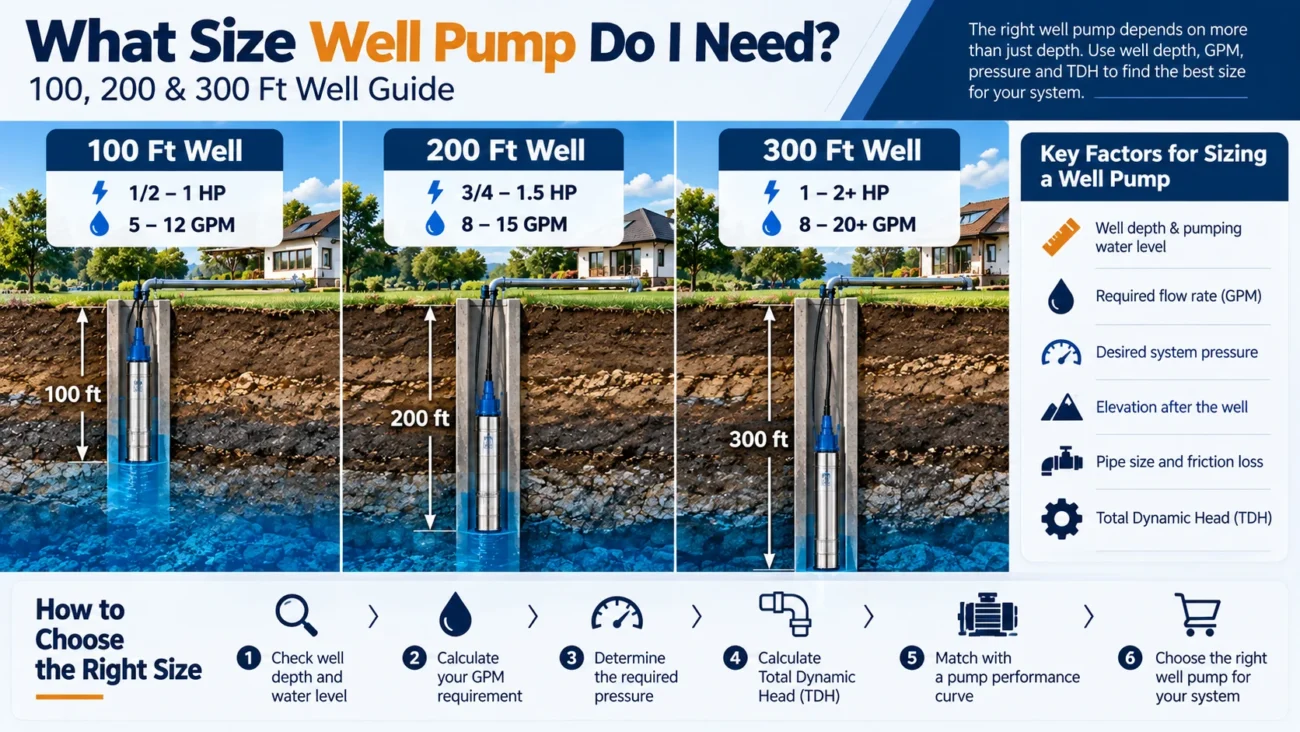
Well depth is an important starting point, but it is not the only factor. The correct well pump size by depth also depends on the pumping water level, required GPM, pressure requirements, pipe size, friction loss, and Total Dynamic Head (TDH).
In this guide, we’ll explain how to choose the right pump for different well depths and compare common options such as 1 HP, 1.5 HP, and 2 HP submersible well pumps.
Table of Contents
Why Well Depth Matters When Choosing a Pump
A well pump must create enough pressure to move water vertically from the pumping water level to the surface and then through the plumbing system. Generally, deeper wells require pumps capable of operating against higher head pressure. However, there is an important distinction between well depth and pumping water level.
A well may be 300 ft deep while the actual water level during pumping is only 150 ft below the surface. The pump does not necessarily need to continuously lift water the entire 300 ft. This is why selecting a pump based only on total well depth can lead to an oversized or undersized system.
Before choosing a pump, determine:
- Total well depth
- Static water level
- Pumping water level
- Required flow rate in GPM
- Desired system pressure
- Vertical elevation after the well
- Pipe diameter and length
- Friction loss
- Total Dynamic Head (TDH)
These factors provide a much better basis for choosing the correct well pump.
What Size Pump Do I Need for a 100 Ft Well?
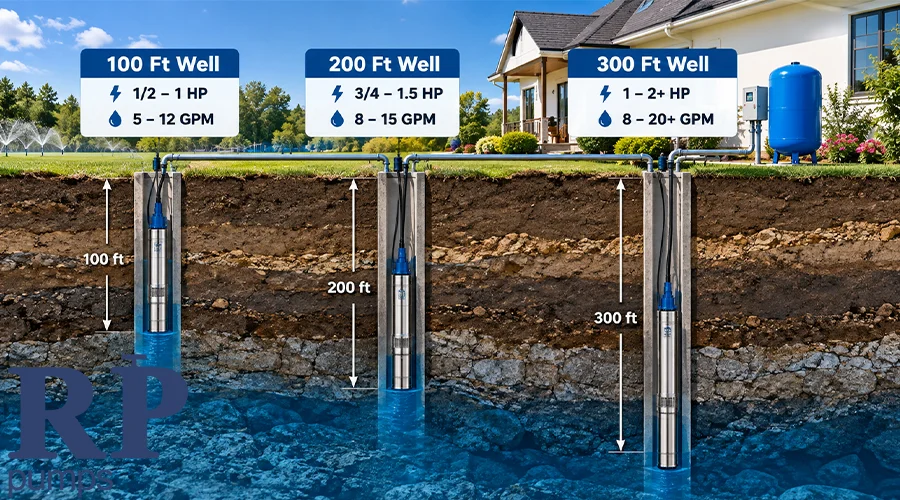
For relatively shallow wells around 100 ft deep, many residential systems can operate with a smaller submersible well pump, depending on the pumping water level and water demand. A pump size for a 100 ft well might commonly fall around the 1/2 HP to 1 HP range for residential applications, but horsepower alone should never determine your final selection.
For example, a home with moderate water demand may require approximately 8–12 GPM, while a larger household or irrigation system could require considerably more.
A typical selection process might consider:
Well depth: 100 ft
Required flow: 8–12 GPM
Possible pump range: approximately 1/2–1 HP
Pump type: typically submersible for deeper installations
The actual pump should be selected by checking its performance curve at your calculated TDH. If the pump delivers the required GPM at that head, it may be suitable for your system.
Related article: For more information about what size water pump do i need, click the link.
What Size Pump Do I Need for a 200 Ft Well?
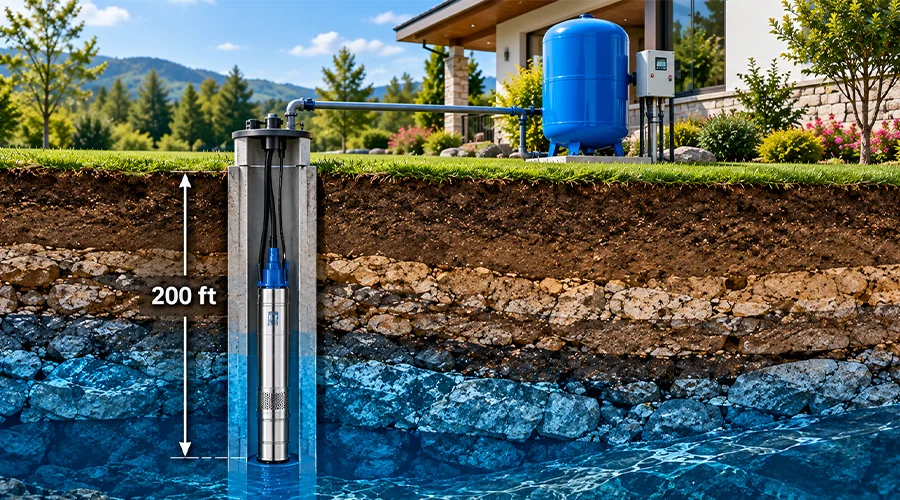
Choosing the correct pump size for a 200 ft well requires more attention to head pressure. At this depth, a submersible well pump is generally the practical choice because it pushes water upward rather than relying on suction from the surface.
Depending on pumping water level, required pressure, and flow rate, applications in this range may use pumps around 3/4 HP, 1 HP, 1.5 HP, or potentially larger.
For example:
Well depth: 200 ft
Required flow: 10–15 GPM
Possible pump range: approximately 3/4–1.5 HP
Recommended type: submersible well pump
If you’re searching for a submersible pump for a 200 ft well, don’t choose one simply because its product description mentions a maximum depth greater than 200 ft.
Instead, check how much water the pump can actually deliver at your system’s required head. A pump might technically lift water 200 ft but provide insufficient GPM at that operating point.
Related article: For more information about submersible well pump sizing chart, click the link.
What Size Pump Do I Need for a 300 Ft Well?
Deep wells create more demanding pumping conditions. When selecting a pump size for a 300 ft well, Total Dynamic Head becomes especially important because small differences in pumping level, elevation, pressure requirements, and friction losses can significantly affect pump performance. A submersible pump for a 300 ft well may commonly require 1 HP, 1.5 HP, 2 HP, or more depending on the application.
A possible residential scenario could look like this:
Well depth: 300 ft
Required flow: 10–15+ GPM
Possible pump range: approximately 1–2+ HP
Recommended type: deep-well submersible pump
However, this does not mean every 300 ft well needs a 2 HP pump. If the pumping water level is much higher than the bottom of the well, the actual head requirement may be significantly lower. Likewise, a system supplying irrigation, multiple buildings, livestock, or high-demand equipment may need considerably more capacity than a standard home.
For narrow well installations where space is limited, a 1 inch diameter submersible well pump can provide a compact solution while still delivering reliable water flow for the right application.
Well Pump Size Chart by Depth
The following chart can be used as a general starting point—not as a final pump-sizing specification.
Well Depth | Typical Pump Type | Approximate HP Range | Example Flow Requirement |
Up to 100 ft | Submersible / suitable well pump | 1/2–1 HP | 5–12 GPM |
100–200 ft | Submersible | 3/4–1.5 HP | 8–15 GPM |
200–300 ft | Deep-well submersible | 1–2+ HP | 8–20+ GPM |
300+ ft | Deep-well submersible | Application-specific | Application-specific |
These numbers should not replace a proper pump calculation. Two 200 ft wells can require completely different pumps because their pumping water levels, GPM requirements, elevation changes, and desired operating pressures may be different. Therefore, when looking for a well pump HP by depth, use depth only as the first step in the selection process.
How Much GPM Does Your Well Pump Need?
After determining the approximate depth and head, you need to determine how much water your system requires. GPM stands for gallons per minute and represents the pump’s flow rate. The question “what GPM well pump do I need?” depends largely on how much water may be used at the same time.
A small household may have significantly lower demand than a large property with several bathrooms, irrigation zones, livestock watering systems, or other water-consuming equipment.
Fixtures such as showers, toilets, sinks, washing machines, dishwashers, outdoor faucets, and irrigation systems all contribute to peak demand. The goal is to choose a pump capable of meeting realistic peak demand without exceeding the sustainable production rate of the well.
Bigger GPM Is Not Always Better
Installing a pump with a much higher flow rate than necessary does not automatically improve the system. The well itself must be capable of producing enough water. If the pump removes water faster than the well can recover, the water level can fall significantly and potentially create operating problems.
The correct approach is to balance:
Well production + household demand + pump capacity + pressure system capacity.
How to Calculate Total Dynamic Head (TDH)
Total Dynamic Head is one of the most important measurements when sizing a well pump.
In simplified terms:
TDH = Vertical Lift + Required Pressure Head + Friction Loss + Additional Elevation
Vertical Lift
This is based primarily on the vertical distance the water must travel from the pumping water level to its delivery point.
Pressure Head
Your plumbing system also requires pressure.
A useful conversion is:
1 PSI ≈ 2.31 feet of head
For example, maintaining 50 PSI represents approximately:
50 × 2.31 = 115.5 ft of head
This pressure requirement must be considered in addition to vertical lift.
Friction Loss
As water travels through pipes, fittings, valves, elbows, and other components, some pressure is lost due to friction.
Longer pipes, smaller pipe diameters, and higher flow rates can increase these losses.
Example
Imagine a system with:
- Pumping water level: 150 ft
- Required pressure: 50 PSI
- Pressure head: approximately 116 ft
- Estimated friction and other losses: 20 ft
The approximate TDH would be:
150 + 116 + 20 = 286 ft TDH
You would then look at the manufacturer’s pump curve and find a model capable of delivering your required GPM at approximately 286 ft of head.
This is much more accurate than simply asking for a “pump for a 200 ft well.”
1 HP vs 1.5 HP vs 2 HP Well Pumps
Another common question is: what HP well pump do I need? Horsepower indicates motor power, but it does not directly tell you how much water a pump will deliver at your required pressure.
1 HP Well Pump
A 1 HP well pump can be suitable for many residential systems with moderate depth and water demand.
Depending on the specific pump design, it may work well for:
- Residential water supply
- Moderate-depth wells
- Standard household demand
- Smaller irrigation requirements
1.5 HP Well Pump
A 1.5 HP model provides additional capacity and may be appropriate when the system has:
- Greater pumping depth
- Higher TDH
- Higher GPM requirements
- Additional elevation
- Larger residential or light agricultural demand
When comparing a 1 HP vs 1.5 HP well pump, don’t automatically assume the 1.5 HP model is better.
The correct choice is whichever pump meets the required operating point efficiently.
2 HP Well Pump
A 2 HP well pump may be appropriate for deeper wells, higher flow requirements, or systems operating against substantial head.
Potential applications include:
- Deep residential wells
- Irrigation
- Agricultural water systems
- Larger properties
- Higher-head applications
Again, a 2 HP pump should not be installed simply because the well is deep. Oversizing can increase initial cost and may create inefficient system operation.
When Should You Choose a Submersible Well Pump?
Submersible pumps are installed below the water level inside the well. Instead of pulling water from above, they push water toward the surface. This makes them especially suitable for deeper wells.
For wells around 100, 200, or 300 ft deep, a properly sized submersible pump is often the most practical solution.
Advantages can include:
- Effective operation in deep wells
- Good pressure capability
- Reliable residential water supply
- Efficient water delivery when properly sized
- No surface suction limitations associated with shallow-well configurations
The key is matching the pump’s performance curve to the required GPM and TDH.
2-Wire vs 3-Wire Submersible Well Pumps
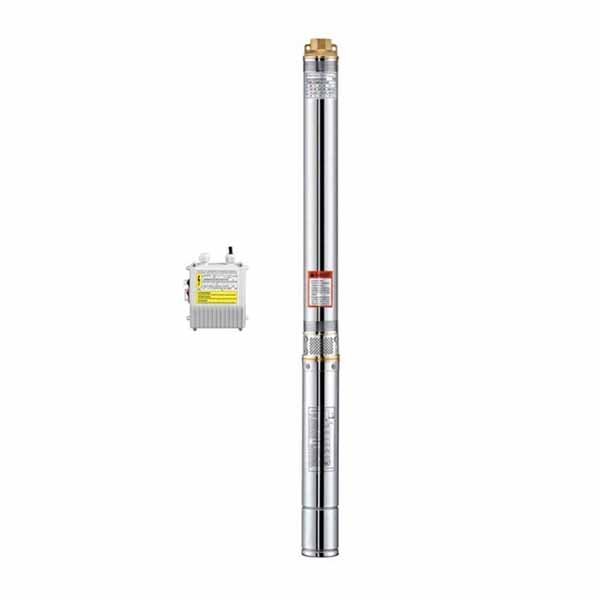
Once you’ve determined the approximate pump size, another decision may be whether to choose a 2-wire or 3-wire submersible well pump. A 2-wire pump generally has its starting components built into the motor assembly, which can simplify installation.
A 3-wire system typically uses an external control box containing starting components. The best option depends on the motor, system design, installation, service requirements, and available electrical configuration.
If you’re comparing these two options before purchasing, read our complete 2-Wire vs 3-Wire Submersible Well Pumps guide.
How to Choose the Right Well Pump Before Buying
Before purchasing a well pump, collect the specifications of your water system rather than choosing based only on horsepower or maximum advertised depth.
You should know:
- Well depth
Determine the total drilled depth of the well.
- Static water level
Measure the water level when the pump is not operating.
- Pumping water level
Determine the water level while the system is operating. This measurement is particularly important for calculating actual lift.
- Required GPM
Estimate the property’s peak water demand.
- Desired pressure
Consider the pressure switch settings and pressure requirements of the building or equipment.
- Total Dynamic Head
Combine vertical lift, pressure head, friction losses, and additional elevation.
- Electrical requirements
Check voltage, phase, wiring configuration, motor requirements, and whether the installation requires a control box.
- Pump performance curve
Finally, verify that the selected pump delivers the required GPM at your calculated TDH.
Common Mistakes When Sizing a Well Pump
Avoid these common mistakes before purchasing:
- Choosing a pump based only on total well depth
- Buying the highest HP available
- Ignoring pumping water level
- Ignoring the well’s recovery or production rate
- Selecting GPM without calculating actual demand
- Forgetting pressure requirements
- Ignoring pipe friction and elevation
- Choosing a pump based only on maximum head
- Failing to check the manufacturer’s performance curve
- Installing a pump that exceeds the well’s sustainable capacity
Correct sizing can improve water pressure, system reliability, energy efficiency, and pump life.
Conclusion
Choosing the right well pump starts with understanding your system—not simply selecting a pump based on the number printed on the motor. Whether you’re looking for a pump size for a 100 ft well, a submersible pump for a 200 ft well, or a submersible pump for a 300 ft well, consider the complete operating conditions:
Well depth + pumping water level + GPM + pressure + friction loss + TDH.
Once these values are known, compare them with the manufacturer’s pump performance curve to find a model capable of delivering the required flow at the required head.
The right pump is not necessarily the largest pump. It is the pump that matches your application’s operating point while providing reliable and efficient water delivery.
If you’re ready to replace or install a well pump, explore the available well pump options at RP Pumps Online and compare models based on horsepower, voltage, flow requirements, and your specific well conditions.
FAQs
What size well pump do I need for a 100 ft well?
Many residential 100 ft well applications may use pumps in the approximate 1/2 HP to 1 HP range. However, the correct size depends on pumping water level, required GPM, pressure, TDH, and the pump’s performance curve.
What size pump do I need for a 200 ft well?
A pump size for a 200 ft well may commonly fall around 3/4 HP to 1.5 HP for residential applications, but actual requirements vary considerably. Calculate TDH and required GPM before selecting a model.
What size pump do I need for a 300 ft well?
A pump size for a 300 ft well may be around 1–2 HP or more depending on pumping water level, flow requirements, pressure, and system configuration. Deep wells typically use submersible pumps.
Is a 1 HP pump enough for a 200 ft well?
It can be, but not in every situation. Check the specific 1 HP pump’s performance curve to determine whether it provides your required GPM at the calculated TDH.
Is a 1.5 HP well pump better than a 1 HP pump?
Not necessarily. A larger motor is useful only when the system requires the additional performance. Correct sizing is more important than simply choosing higher horsepower.